

Faso Dan Fani: Understanding Its Origins, Patterns, and Quality
Can a fabric carry both a history and an identity? Yes: the woven cotton of Faso Dan Fani, also known as Faso Danfani, literally means "the woven cloth of the homeland". Woven in West Africa, it is a national symbol of Burkina Faso. In 1986, Thomas Sankara declared that wearing it was an economic, cultural, and political act of defiance against imperialism.
We often notice the colors and patterns first. But behind every piece of woven cotton Faso Dan Fani, there is craftsmanship: the cotton is spun, then woven by hand on traditional looms. The resulting strips are assembled to form a wider fabric, whose textures and patterns vary according to the artisanal work.
Here you will discover what Faso Dan Fani represents, how its patterns take shape, and what details help you appreciate the quality of its woven cotton. We will also see why its handmade production gives each piece of cloth a unique character, far from the uniformity of mass production.
Key takeaways
- Understand why this textile is associated with Burkinabè identity and pride.
- See how artisanal weaving and the assembly of strips shape the patterns.
- Learn what details to look for to appreciate the texture and quality of the fabric.
- Identify the factors that influence the price of a piece of cloth by the meter or as a pagne.
Origin and meaning of Faso Dan Fani
In Burkina Faso, Faso Dan Fani is a cotton cloth woven in West Africa and a national symbol. Its history links an artisanal textile to the country's cultural pride and economic independence.
Origin of Faso Dan Fani
Faso Dan Fani finds its origins in cotton weaving in Burkina Faso. Writings by anthropologists and explorers mention it as early as the 19th century, bearing witness to an ancient tradition. This context allows us to understand that the fabric is part of a craftsmanship rooted in the country's history, rather than just a pattern. The cotton strips assembled into cloth thus make full sense.
Meaning of Faso Dan Fani
"Faso Danfani" literally means "the woven cloth of the homeland". In the 1980s, Thomas Sankara, who led Burkina Faso from 1983 to 1987, promoted it as a symbol of national pride and economic independence. In 1986, he declared that wearing it constituted an economic, cultural, and political act of defiance against imperialism. This history sheds light on the meaning of the textile: wearing it also expresses an attachment to a collective identity.
The political dimension of Faso Dan Fani is linked to local production. By promoting cotton woven in Burkina Faso, Thomas Sankara encouraged cultural affirmation and economic independence. The fabric carries several meanings, from belonging to the country to the recognition of artisanal work.
In Burkina Faso, Faso Dan Fani is worn daily as well as on special occasions. Women tie it around their waists, while men wear it in the form of sewn traditional clothing. These uses show that the cloth accompanies both everyday life and important moments.
The labeling of Faso Danfani aims in particular to protect the textile against counterfeiting and to promote its recognition on international markets. This approach highlights its cultural identity and origin, although no precise certification can be inferred from this information alone.
To care for Faso Dan Fani, hand washing is recommended. This practice takes care of the cotton cloth and respects its artisanal weaving.
Artisanal weaving and pattern creation
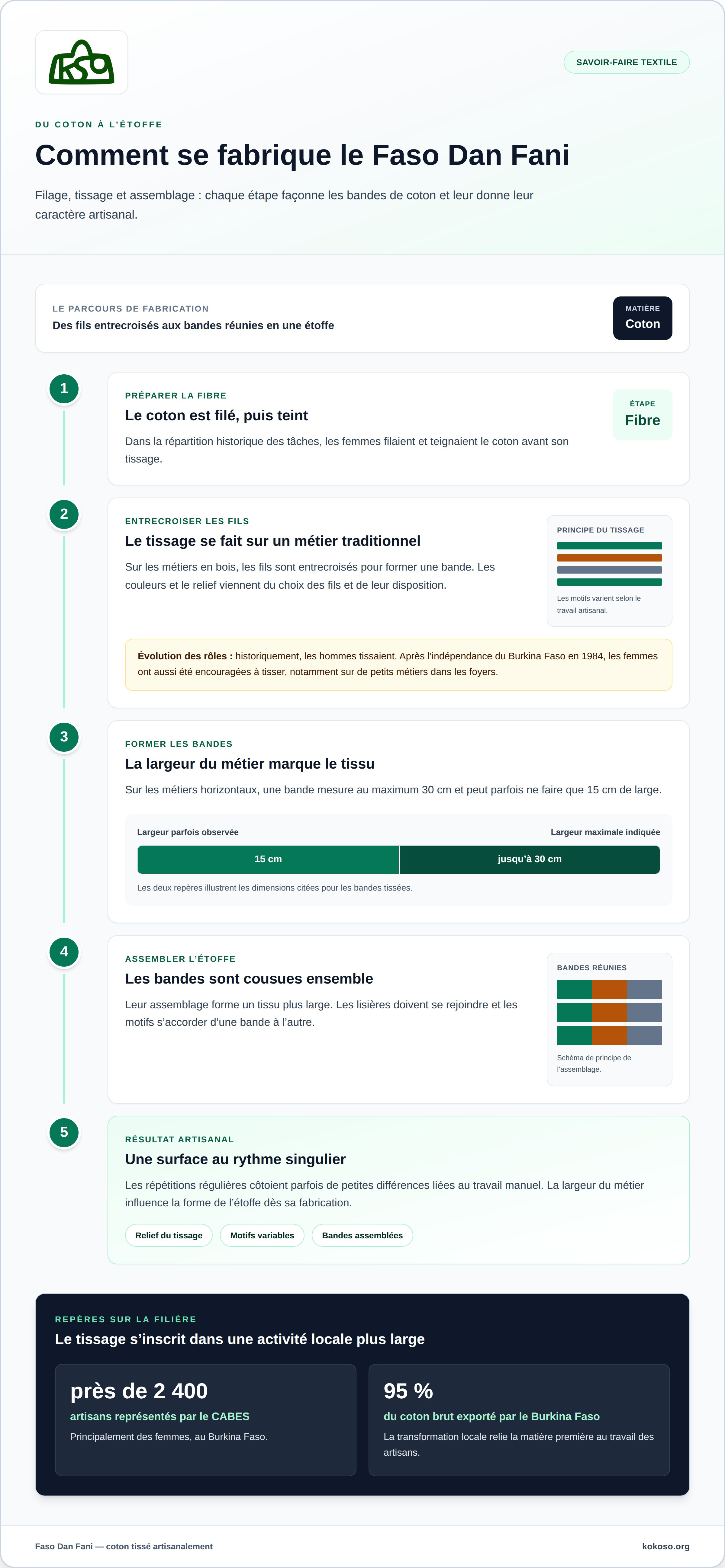
In Burkina Faso, artisans weave cotton on traditional wooden looms. They interlace the threads to form a strip, whose colors and texture compose the pattern. Several strips can then be sewn together to create a wider piece of cloth. The width of the loom therefore influences the shape of the fabric from the time of its manufacture. The design arises as much from the choice of threads as from their arrangement on the loom.
Historically, tasks were divided between women and men. Women spun and dyed the cotton, while men wove it on horizontal looms. After Burkina Faso's independence in 1984, women were also encouraged to weave. This development encouraged the use of small looms in households. It thus expanded the role of female artisans in the production of strips and cloths.
On horizontal looms, the strips measure a maximum of 30 cm wide and can sometimes measure only 15 cm. Their assembly requires special attention: the edges must meet and the patterns must match from one strip to the next. Variations in color and weave give rhythm to the surface. Regular repetitions sometimes coexist with small differences related to manual work.
What is the economic impact of Faso Dan Fani on local weavers and producers? Its manufacture involves different stages and trades, from spinning and dyeing to weaving, creating activities for the artisans involved. CABES represents nearly 2,400 artisans in Burkina Faso, mainly women.
The local processing of cotton remains an economic challenge: Burkina Faso exports 95% of its raw cotton. In January 2022, a conference dedicated to the local processing of cotton in Africa illustrated the interest shown in this sector. Processing cotton locally links the production of raw materials to the work of artisans, without confusing the place of cultivation with that of spinning or weaving.
Quality and characteristics of the fabric
To appreciate a piece of cloth, observe its surface under even lighting. The weave should remain visible, without abnormally loose areas or threads that come away when touched. Also examine the edges and seams: careful finishing helps the fabric retain its shape with use. These clues provide information about the quality of workmanship, but do not certify the origin on their own.
Touch provides another guide. Gently run your hand over the cotton and note its softness, texture, and thickness. For an accessory worn often, the fabric must also suit the intended use: a fabric that is pleasant to the touch is not necessarily suitable for all demands. Consider the function of the piece rather than relying solely on its appearance.
Next, observe the regularity of the surface and the neatness of the joins. Small differences may appear from one area to another in an artisanal piece; they are not automatically a sign of poor quality. However, pulled threads or a seam coming apart are concrete defects, to be distinguished from visual variations in the pattern.
How does Faso Dan Fani compare to kente and other African fabrics? Compare their materials, finishes, and regularity of workmanship rather than ranking them on a single scale. Each textile has its characteristics: examine the piece and consider the use for which you intend it.
Quality is not to be confused with authenticity. An artisanal appearance may catch the eye, but is not enough to establish the origin of a fabric. Information about provenance and manufacture provides complementary context to observable clues. For a piece worn regularly, assess together the material, finishes, and care of the seams.
Finally, adapt the care to the cloth rather than applying a general rule to all fabrics. For the Faso Dan Fani offered, hand washing is recommended. Gentle washing helps preserve the appearance of the cotton and the integrity of the joins over time.
How much does Faso Dan Fani cost by the meter or as a pagne?
The price of a piece of cloth depends on what is being sold and how it is made. For a sale by the meter, the length purchased is included in the calculation; for a pagne, the price is for a whole piece. Hand weaving takes time, and spinning, dyeing, and assembly also influence the amount of work required. Therefore, distinguish the price of the raw fabric from that of an already made item.
Width also matters. In Burkina Faso, a strip can measure 15 cm, or reach a maximum of 30 cm. Several strips are assembled to form a wider piece of cloth. This construction influences the amount of work and material required for the final piece. Two pagnes of the same length can thus differ in their width, patterns, and the complexity of their assembly.
Material and finishes also matter. Hand-spun cotton, a special dye, or a pattern requiring more steps influences the artisanal work. To compare two offers, check the unit of sale, dimensions, type of cotton, and how the strips are assembled. The displayed price alone does not always allow for a fair comparison.
In Switzerland, ask for an amount in CHF and specify whether the purchase is by the meter or as a pagne. Also check the indicated length and width, as the word "pagne" does not specify the dimensions on its own. For a particular project, the required length depends on the cut and intended use. These details help you understand what the price covers and distinguish a woven cloth from a made item.
Kokoso
kokoso incorporates Faso Dan Fani into everyday accessories. Its pieces are made with hand-spun cotton, then woven artisanally on a loom. Each piece is unique. The fabric thus becomes part of an object that you wear or carry with you.
The brand offers handbags, backpacks, travel bags, and fanny packs made with African fabrics. These accessories allow you to discover Faso Dan Fani in a different way than as a pagne and to see the variations in the material.
The Faso Dan Fani creations include several types of accessories, adapted to different uses.
Make a place for craftsmanship in your daily life
An artisanal textile can also inspire a more personal choice of accessory. Think about the use: carrying your belongings every day, going on a trip, or keeping the essentials close at hand. This reflection helps you choose a suitable shape, while letting the pattern and material express their character. The woven cotton of Faso Dan Fani is not reduced to its appearance: it also carries an artisanal gesture and a cultural history. Integrating it into your daily life means appreciating these dimensions beyond the cloth.
To discover how this material takes place in handbags, backpacks, and travel bags, contact kokoso. Choose an accessory that suits you and let the work of the female and male artisans accompany your days.
Frequently asked questions about Faso Dan Fani
What is Faso Dan Fani and how is it made?
Faso Dan Fani refers to a traditional cloth from Burkina Faso, not a unique pattern or a particular cut of clothing. This distinction is useful: the fabric can be transformed into different objects without losing its textile identity. To understand a creation, distinguish three elements: the fabric, its pattern, and the object made with it.
What are the steps in weaving Faso Dan Fani cotton?
To follow the manufacture, think of a succession of gestures: preparing the thread, setting it on the loom, interlacing the threads, then assembling the strips if necessary. Each step leaves different clues. The weave bears witness to the work on the loom; the joins reveal the assembly. This reading helps to describe the manufacture without confusing the final appearance with the gestures that produced it.
What is the historical origin of Faso Dan Fani in Burkina Faso?
The history of Faso Dan Fani is not limited to a recent political period: writings by anthropologists and explorers mention it as early as the 19th century. To situate a piece of cloth, remember two complementary dimensions: its presence in historical accounts and its importance as a Burkinabè symbol. You can thus speak of its heritage without reducing it to an event or a person.
What cotton and patterns are used for Faso Dan Fani?
The cotton may come from a local supply chain; the National Union of Cotton Producers of Burkina Faso provides artisans with organic thread presented as GOTS certified. This does not mean that every piece of cloth necessarily uses this thread. The patterns vary according to the choices of colors and composition: no single design defines all pieces.
How to recognize a hand-woven Faso Dan Fani from an industrial imitation?
Appearance alone does not allow you to authenticate a piece of cloth with certainty: visible variations do not automatically prove that it was woven by hand. To assess a piece, consider together its provenance, the indications about its manufacture, and its textile characteristics. Labeling aims in particular to combat counterfeiting and to strengthen the recognition of Faso Dan Fani on international markets.
What labeling rules or certifications apply to Faso Dan Fani?
Labeling aims to protect Faso Dan Fani against counterfeiting and to strengthen its recognition on international markets. The UNPCB provides artisans with organic cotton thread presented as GOTS certified.