

African wax backpack: capacity, comfort and price
An African wax backpack is not chosen solely for its pattern: capacity and comfort are just as important. When comparing models, check the usable space, storage organization, shoulder strap support, and ease of everyday wear.
You are looking for a bag that expresses your style without becoming bulky or impractical. A vibrant print catches the eye, but size, shape, and construction also determine whether the bag suits your commutes and belongings. A model for daily travel does not necessarily meet the same needs as a weekend companion.
In this guide, you will discover how to compare the capacity, comfort, patterns, and prices of African wax backpacks according to your needs, rather than choosing based on appearance alone. We will look at which storage features to examine, which details affect wearability, how to distinguish styles, and what criteria to consider to understand price differences on the Swiss market.
Key takeaways
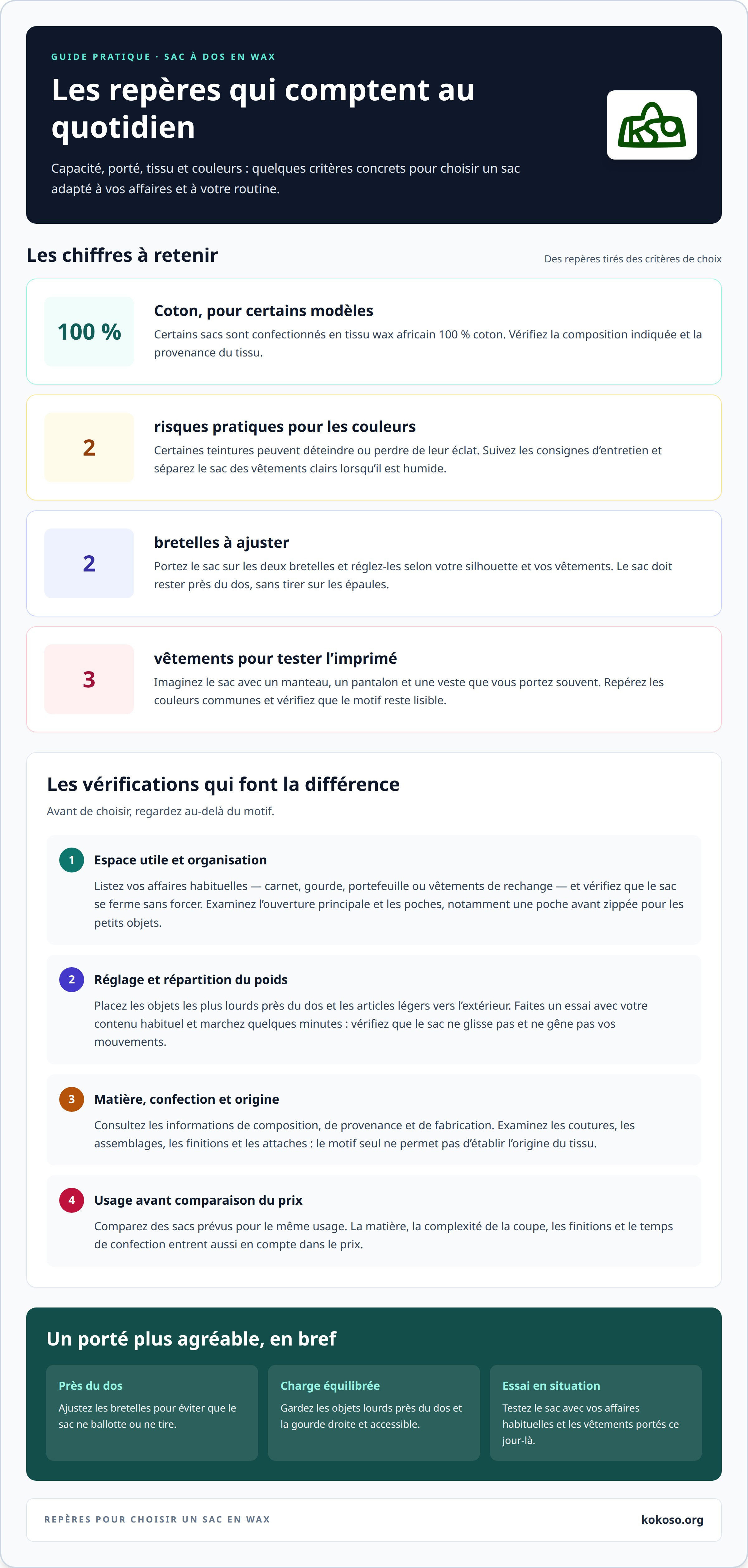
- Assess capacity based on what you carry and the organization of the compartments, not just the bag's appearance.
- For more comfortable wear, examine the shoulder straps and their adjustability according to your daily use.
- Compare patterns and colors to your style, while also considering the material and construction.
- To assess the price, consider the intended use, finishes, and craftsmanship together.
Compartments and storage capacity
Usable capacity depends on what you carry every day: a notebook, water bottle, wallet, or change of clothes. Start by making a list of your usual belongings, then check that the bag can accommodate them without straining the closure. A bag that appears spacious may offer little room if its shape is narrow or its pockets are bulky.
An African print backpack may feature a zippered front pocket and a top handle. The pocket allows you to separate small items, such as keys or a transit pass, from the main contents. The handle makes it easier to pick up when the bag is set down. Also examine the main opening: a wide opening makes it easier to pack and access your belongings.
When choosing materials and construction quality, opt for a clearly stated composition and examine the seams, assembly, and consistency of the finishes. Some bags in this category are made from 100% cotton African wax fabric or traditional bogolan. The choice depends on the desired feel and appearance, while neat seams and securely attached fasteners contribute to regular use.
To check the authenticity and origin of African wax fabric, consult the composition, origin, and manufacturing information provided with the bag. Precise information about the fabric and its origin is more useful than a simple mention of "African print." The pattern alone does not establish the origin: look for consistent information between the description, label, and product presentation.
Finally, adapt the organization to your routine. For a workday, separate the notebook from small accessories; for an outing, ensure there is enough room for a water bottle. A well-chosen bag keeps these items accessible without encouraging you to carry unnecessary volume. Capacity therefore depends not only on size, but also on organization suited to your belongings.
Strap comfort and lightness
Adjustable shoulder straps allow you to fit the bag to your figure and the clothes you are wearing. Adjust them so the bag stays close to your back without pulling on your shoulders. For example, if you wear a thick coat in Geneva during winter, readjust them rather than keeping the setting used with a light top. Straps that are too long can cause the bag to bounce; if too short, they can create uncomfortable tension.
Perceived weight also depends on how you fill the main compartment. Place the heaviest items close to your back, then the lighter items toward the outside. A computer or rigid book placed at the bottom can pull the bag backward; rearrange the contents to bring the load closer to your body. Keep the water bottle upright and accessible rather than letting it roll freely among your belongings.
Before a day of travel, test it with your usual contents: wallet, notebook, keys, and bottle. Put on both straps, adjust them, then walk for a few minutes. Check that the bag does not slip and that its top edge does not interfere with your movements. If you often have to carry it on one shoulder to catch the tram, put it back on both straps as soon as possible.
Lightness is not judged solely when empty. A compact model can become heavy once filled with dense objects; a more spacious bag may encourage you to carry more. For a daily commute between home and the office, keep only the necessary items and distribute them in the bag. Adjustable straps help adapt the fit, but do not compensate for an unbalanced load. A quick adjustment before leaving can improve comfort throughout the journey.
Colorful patterns and afro-urban style
A wax bag may feature geometric shapes, repeating lines, or highly contrasting compositions. Colorful patterns vary from one model to another: first choose the desired effect. A dense print catches the eye, while a more spaced-out design allows the overall look to breathe more. The pattern thus becomes a statement piece rather than a simple detail.
To put together an urban outfit, start with a color present on the bag. With a print combining yellow and blue, a solid coat in one of these shades creates a clear connection. Jeans and understated shoes also allow the pattern to express itself without multiplying contrasts. For a bolder style, combine two colors already present in the print, then keep the rest of the outfit simple.
Colorful patterns do not all match in the same way. Before choosing, imagine the bag with three pieces of clothing you wear often, for example a coat, trousers, and a jacket. Identify the common colors, then observe whether the shapes remain visible from a distance. This step helps distinguish a visual crush from an accessory you will enjoy wearing often.
Dyes can present two practical risks: some colors may bleed or lose their vibrancy. Their durability depends notably on the dye and care; follow the instructions associated with the fabric and avoid harsh treatments. To limit color transfer, keep the bag away from light-colored clothing when it is damp.
Durability also depends on use and the areas under stress. A bag carried every day rubs more against a coat or chair than a model reserved for outings. Examine the seams around the straps and the bottom, then adapt the organization to avoid unnecessary tension. The pattern can thus express your style without overshadowing the importance of construction.
Model prices
The price of an African wax backpack depends on several elements, not just the pattern. The material, the complexity of the cut, the finishes, and the time required for construction are also taken into account. Therefore, compare models intended for the same use, for example an everyday bag with another everyday bag, rather than with a large travel model.
To compare a handcrafted bag and an industrial model, examine the manufacturing, seams, finishes, and consistency of the pattern. Handcrafted work may involve piece-by-piece construction, while industrial production generally follows repeated steps. These differences help explain the price, but are not sufficient, on their own, to judge quality.
A simple method is to read each description in the same order:
- Identify the fabric composition, such as cotton wax or bogolan.
- Observe the manufacturing details, especially the seams and fasteners.
- Assess the organization, for example the presence of a zippered pocket.
- Relate these features to your use, such as daily commutes or outings.
A rich pattern may require careful cutting to align the shapes across the different pieces. Meticulous finishes are noticeable at the joins, edges, and tension points, especially near the straps. Compare these details to the listed price, rather than relying on a general promise of quality.
In Switzerland, compare offers in the same currency and check what is included in the displayed amount, such as delivery. Do not directly convert a foreign price into Swiss francs: fees and terms of sale may differ. To compare effectively, note the price, material, finishes, and intended use for each model. You will thus see whether the difference is due to concrete differences or mainly to the chosen style.
kokoso: Backpacks
kokoso offers backpacks for those looking for a practical accessory with a distinctive character. To choose, start with your use: daily commutes, outings, or things to carry. The model can thus fit into your habits while bringing an expressive textile touch.
If you are looking for another shape, the range also includes handbags, travel bags, and fanny packs. You can thus choose a format suited to your daily life, rather than an accessory that does not meet your needs.
To discuss your choice, contact kokoso.
Choose a bag suited to your needs
To choose your next bag, consider its use and its place in your daily life. Think about the commutes it will accompany you on, the clothes you will wear it with, and the style you prefer. An African wax backpack can bring a distinctive touch to a familiar outfit without imposing a uniform style. The main thing is to choose a piece suited to your needs that you can use regularly.
Before deciding, keep in mind your actual use and your preference for expressive or more discreet prints. This choice may evolve with your habits: a bag that accompanies you to work does not necessarily meet the needs of an accessory for going away for a few days. Take the time to think about the place of this piece in your daily life, beyond its appearance on a screen. To get information about your choice, contact kokoso.
Frequently asked questions about African wax backpacks
What is an African wax fabric backpack?
It is a backpack made with African wax fabric, recognizable by its colorful print. The fabric makes up a visible part of the bag and gives it its graphic identity. Depending on the model, the material may differ: some creations use wax, others Faso Dan Fani, a handwoven cotton. Check the model description to find out which textile is used.
What styles and patterns of wax backpacks are available?
Models come in several colorful patterns, from geometric compositions to denser prints. To choose, think about the clothes you wear often: a bag with dominant shades can easily match a sober wardrobe, while a contrasting pattern becomes the highlight of an outfit. Faso Dan Fani offers another visual texture, linked to its manual weaving.
How much does an African wax backpack cost in Switzerland?
The price varies depending on the model and its features, notably the material, construction, and finishes. There is therefore no single price for all African wax backpacks. To compare the amounts displayed in Switzerland, put models intended for the same use side by side and take into account the delivery fees indicated at the time of purchase.
What criteria to choose for an African wax backpack suited for school or travel?
For school, choose a bag that accommodates the items carried every day and whose closure allows you to access them easily. For travel, consider the clothes or accessories to carry and favor a practical organization. In both cases, check the dimensions, pockets, closure, and strap adjustability. A pleasant pattern also counts, but must accompany realistic use.
How to care for and clean an African wax fabric backpack?
Follow the fabric care instructions and avoid harsh treatments. When damp, keep the bag away from light-colored clothing to limit color transfer.