

Faso Dan Fani Bags: Price, Cotton and Dimensions to Help You Choose
When choosing Faso Dan Fani handbags, first look at the cotton, dimensions, and origin of the fabric: these indicators help you understand what you are buying beyond the colors and patterns.
Faso Dan Fani also embodies Burkinabè craftsmanship: the cotton is spun, dyed, and then woven by hand, according to a tradition passed down from generation to generation. Although the official label came into effect in 2021, understanding its role helps you better interpret authenticity indicators without confusing pattern with origin.
You will discover here how weaving and dimensions influence the choice of a Faso Dan Fani handbag, what its origin reveals about its production, and what the labeling can tell you. These indicators help you better understand the material, dimensions, and origin of the bag.
Key takeaways
- Choose the size based on what you carry and how you want to wear your bag.
- Look for weaving characteristics to better understand the texture and construction of the fabric.
- The label provides concrete criteria to distinguish compliant production from a simple pattern inspired by Faso Dan Fani.
- Follow the production steps to better appreciate the artisanal work and choose a piece that suits you.
Cotton and bag dimensions
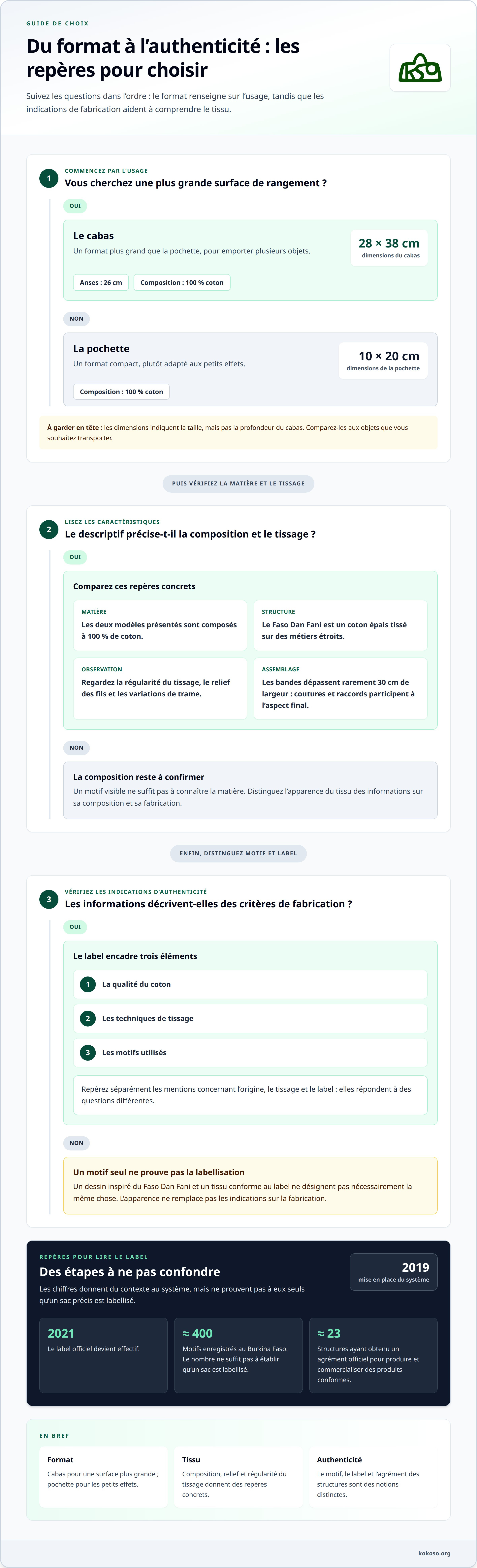
Cotton and measurements provide two concrete indicators for choosing a bag. The Faso Dan Fani tote measures 28 × 38 cm, with 26 cm handles. The pouch measures 10 × 20 cm. These sizes meet different needs: the former offers more surface area, while the latter remains compact. Before choosing, think about the items you want to carry and the space available in your daily life.
Composition also matters: the tote and pouch presented are both made of 100% cotton. Faso Dan Fani is a thick cotton fabric woven on narrow looms. This material provides a visible texture and a different feel from smooth fabric. To compare two pieces, observe the regularity of the weave, the relief of the threads, and the possible presence of variations in the weft.
Dimensions do not tell the whole story. The 28 × 38 cm size indicates the tote's dimensions but does not specify its depth. The handle length of 26 cm is another practical indicator for considering how to carry the bag. For the 10 × 20 cm pouch, imagine the small items you want to store in it. A phone, wallet, or keys can serve as examples to compare with its measurements.
The narrow weaving also explains the construction of the textile: Faso Dan Fani strips rarely exceed 30 cm in width. The seams and assembly are therefore part of the bag's final appearance. A pattern may show joins or changes in direction depending on how the fabric is laid. These details do not replace dimensions, but they help you appreciate the piece as a whole.
In practice, start with the size, then examine the cotton and weaving. A 28 × 38 cm tote is better suited if you are looking for more storage space than a 10 × 20 cm pouch. Then compare the 26 cm handles with your carrying preference. These indicators make the choice more precise without confusing the appearance of the pattern with the composition of the fabric.
Origin and characteristics of Faso Dan Fani
When choosing a bag, the origin of the fabric provides information about the craftsmanship behind its colors and texture. Its thickness, weaving, and finishes also give indications about its use.
Origin and fabric characteristics
Faso Dan Fani is made in Burkina Faso with cotton grown in the country. In the traditional organization, women spin and dye the fibers, then men weave them on horizontal looms. This manual work transmits craftsmanship from generation to generation. Under the presidency of Thomas Sankara, the fabric was institutionalized as a national symbol between 1983 and 1987.
To assess its hold, compare Faso Dan Fani to a fine cloth: its thick cotton provides more structure. Durability also depends on the weaving, seams, and daily use. A heavy load or repeated rubbing puts more strain on the assemblies, regardless of the fabric.
Available models and styles
Common sizes include the tote and the pouch. The tote is suitable for carrying several items, while the pouch is better suited for storing small belongings. Blue and yellow versions illustrate different color choices. The woven patterns and their variations give each model a distinct appearance without changing the function of its size.
To care for the bag, first remove dust with a soft brush. In case of a stain, dab the area with a clean, slightly damp cloth without rubbing the pattern. Then let it air dry away from a heat source. These steps limit rubbing and preserve the appearance of the fabric.
An online order can be delivered in Switzerland when the seller offers this destination. The delivery conditions, time frame, and fees then depend on their sales terms. Faso Dan Fani regained visibility in Burkina Faso starting in the 2010s, notably after the 2014 popular insurrection, a sign of its enduring cultural roots.
Labeling and authenticity
In Burkina Faso, the Faso Dan Fani labeling system was established starting in 2019. The official label came into effect in 2021. These dates correspond to two stages: the establishment of the system, then the entry into force of the label. They help to situate the process without confusing the age of a pattern with the labeling of a product.
The system has allowed the registration of around 400 patterns in Burkina Faso. This number shows the importance given to the diversity of designs, but is not sufficient, on its own, to establish that a bag is labeled. A pattern inspired by Faso Dan Fani and a fabric compliant with the label do not necessarily refer to the same thing. To choose, therefore, distinguish the appearance of the fabric from the indications regarding its production.
The label sets rules on three elements: the quality of the cotton, the weaving techniques, and the patterns used. These criteria frame different stages of production. Cotton quality concerns the material, the techniques specify the weaving work, and the patterns define the designs allowed within the established framework. Together, they provide more precise indicators than a simple visual reference to a Burkinabè style.
Around 23 organizations have obtained official approval to produce and market Faso Dan Fani products compliant with the established criteria. Approval therefore concerns the production and marketing organizations; it should not be confused with the fabric design. When reading a bag description, separately identify the mentions relating to origin, weaving, and the label. This information answers different questions.
A careful choice relies on several complementary clues. The pattern provides information about the appearance, while the label criteria frame the cotton, weaving, and designs. Official approval concerns the organizations authorized in this process. These concepts are not interchangeable: a colorful or handwoven bag is not automatically labeled. This distinction helps to appreciate authenticity without reducing Faso Dan Fani to its decorative aspect.
How are Faso Dan Fani handbags made?
Once the fabric is ready, the tailoring transforms it into an accessory. The choice of the part of the fabric used influences the appearance of the bag. The pattern is placed according to the desired result, then the pieces are cut to form the different parts. This preparation takes into account the seams and the orientation of the design.
Cutting precedes assembly. The pieces of fabric are brought together to form the body of the bag, then the seams give it its structure. The position of the patterns may vary from one piece to another, notably because the fabric is worked artisanally. This variation makes each assembly unique without changing the function of the model.
The different parts are then assembled according to the shape of the bag. The handles or other carrying elements are attached to the body. Their position contributes to the comfort of use and visual balance. The seams also matter: they connect the pieces of fabric and contribute to the finishing of the product.
The lining and reinforcements complete the construction of the bag. They contribute to its structure and daily use. Their assembly matters as much as the exterior appearance, because the visible fabric does not reveal the quality of the interior finishes on its own. The precise steps may vary depending on the size.
To appreciate the tailoring, observe the bag as a whole: the alignment of the patterns, the regularity of the seams, the attachment of the handles, and the interior finish. These details show how the fabric was assembled and how the different parts form the bag. They also provide concrete indicators for comparing models beyond their color or pattern.
kokoso: Handbags
kokoso offers Faso Dan Fani handbags for those looking for an artisanal piece characterized by its fabric and weaving. The bags are made with hand-spun cotton woven on manual looms in Burkina Faso. Each piece is unique, and limited-edition production preserves the variations inherent in artisanal work.
If you prefer another size, the range also includes backpacks, travel bags, and fanny packs. The choice depends mainly on what you carry and how you want to wear the bag. The kokoso range thus consists of several bag sizes.
Choose a piece that suits you
A Faso Dan Fani handbag can be more than an accessory: it combines a textured material with a fabric that carries a history. To choose, think about your ordinary days: what you carry, your way of getting around, and the style you like. This size is suitable for those who want to incorporate this fabric into their daily life without giving up practicality.
At kokoso, you will find handbags, backpacks, and travel bags. These sizes meet different needs while highlighting the fabric and artisanal work. To choose, take into account your belongings to carry, your travels, and the size that suits you.
To obtain information about the available sizes and selection criteria, contact kokoso. You can compare the models according to their shape, use, and fabric pattern.
Frequently asked questions
What is Faso Dan Fani and what is its origin?
The Faso Dan Fani is a traditional cotton fabric originating from Burkina Faso. Its name refers to the "cloth of the country," and the fabric is associated with Burkinabè cultural identity. It stands out for its artisanal weaving and narrow strips, assembled to form the cloth. For a bag, this origin concerns the fabric used, not necessarily all the stages of production.
How to recognize an authentic and artisanal Faso Dan Fani bag?
Examine the information about the material and production, distinguishing the fabric from the finished bag. A precise description may indicate that the cotton is hand-spun and the fabric woven on a manual loom. Also look at the seams and pattern joins: small variations may reflect the artisanal assembly, but a pattern alone does not prove authenticity.
Which designers or brands offer Faso Dan Fani bags?
kokoso offers bags made with African fabrics, notably pieces in Faso Dan Fani made in collaboration with artisans in Burkina Faso. The brand works in limited editions, and each Faso Dan Fani piece is unique. To compare the creations, examine the fabric description, the weaving method, and the origin of production rather than the pattern alone.
How durable are Faso Dan Fani bags compared to other fabric bags?
Thick cotton gives Faso Dan Fani more structure than a fine cloth. Durability also depends on the weaving, seams, and use: a heavy load or repeated rubbing puts more strain on the assemblies.